Layer 2 and Rollups: Architecture, Bridges and Building on L2s
Master Layer 2 scaling: rollup mechanics, sequencers, bridges, and deployment on Arbitrum, Base, and OP Stack.
About this course
Ethereum’s Layer 2 ecosystem is where most applications will scale. But L2s are not all the same—and choosing the wrong one, or building without understanding sequencers, data availability, and bridges, can cost you millions.
This course teaches you the architecture of optimistic and zero-knowledge rollups, how sequencers work and why decentralization matters, why data availability is the new bottleneck, how bridges fail and how to use them safely, and how to deploy and optimize on Arbitrum, Base, and OP Stack chains.
You’ll work through real examples: analyzing rollup economics, building a ZK circuit, designing a bridge strategy, and deploying a contract to production. By the end, you’ll be able to evaluate any L2, understand its trade-offs, and architect systems that work across multiple chains.
**Who this is for:**
– Blockchain developers building scalable applications
– Protocol engineers evaluating L2 solutions
– Architects designing multi-chain systems
– Teams migrating from Ethereum mainnet to L2
**What you’ll learn:**
– Why Layer 2s exist and the scalability trilemma
– How optimistic and ZK rollups work, and when to use each
– Sequencer design, MEV, and decentralization
– Data availability solutions and their costs
– Bridge mechanics and failure modes
– How to deploy on Arbitrum, Base, and OP Stack
– Gas optimization and UX on L2s
– How to choose the right L2 for your project
**Includes:**
– 7 modules, 24+ lessons with hands-on labs
– Interactive quizzes and knowledge checks
– Capstone project: design an L2 strategy for a protocol
– Shareable certificate of completion
– Lifetime access to course materials and updates
Learn at your own pace. Most learners complete this course in 8–12 weeks.
What you will be able to do
- Can explain why Layer 2s exist and the scalability trilemma trade-offs
- Can distinguish optimistic rollups from ZK rollups and evaluate each for a given use case
- Can describe sequencer design, MEV, and decentralization strategies in rollup systems
- Can evaluate data availability solutions (blobs, alt-DA) and their cost and security implications
- Can identify bridge failure modes and design cross-chain interactions safely
- Can deploy and test smart contracts on Arbitrum, Base, and OP Stack chains
- Can measure and optimize gas costs and user experience on L2s
- Can select the right L2 for an application based on throughput, cost, security, and ecosystem needs
Curriculum
1Why Layer 2s Exist
- Why Ethereum Needs Scaling
- The Scalability Trilemma
- L2 Design Space: Sidechains, Plasma, Rollups
- Rollup Economics and Cost Breakdown
2Optimistic Rollups
- How Optimistic Rollups Work
- Fraud Proofs and Interactive Verification
- Arbitrum Architecture and AVM
- OP Stack Design and Customization
3Zero-Knowledge Rollups
- ZK Rollup Fundamentals
- Building ZK Circuits for State Transitions
- Prover Systems and Hardware
- ZK Rollups in Production
4Sequencers, MEV, and Data Availability
- Sequencer Design and Decentralization
- MEV on L2s and Mitigation
- EIP-4844 Blobs and Cost Reduction
- Alternative Data Availability Solutions
5Bridges and Cross-Chain Safety
- How Bridges Work
- Bridge Failure Modes and Exploits
- Designing Safe Cross-Chain Interactions
- Bridge Economics and Liquidity
6Building on L2s
- Deploying to Arbitrum
- Deploying to Base and OP Stack Chains
- Gas Optimization on L2s
- UX and User Onboarding on L2s
7Choosing and Operating on L2s (Capstone)
- L2 Comparison Framework
- Capstone: Design an L2 Strategy for Your Protocol
Taught by Block Relations
Research & Education · Built for a blockchain developer or protocol engineer who understands Ethereum basics (accounts, smart contracts, gas) and wants to build scalable applications. They need to understand L2 trade-offs, deploy contracts to production L2s, and architect systems that work across multiple chains.
Not sure yet? Start with a free course
 Free
Intro to DeFi: Swaps, Lending and Yield Without Getting Wrecked
Free intro to DeFi: wallets, swaps, liquidity pools, lending, yield, and how to avoid rug pulls. 20+ lessons, quizzes, certificate.
FreeStart free →
 Free
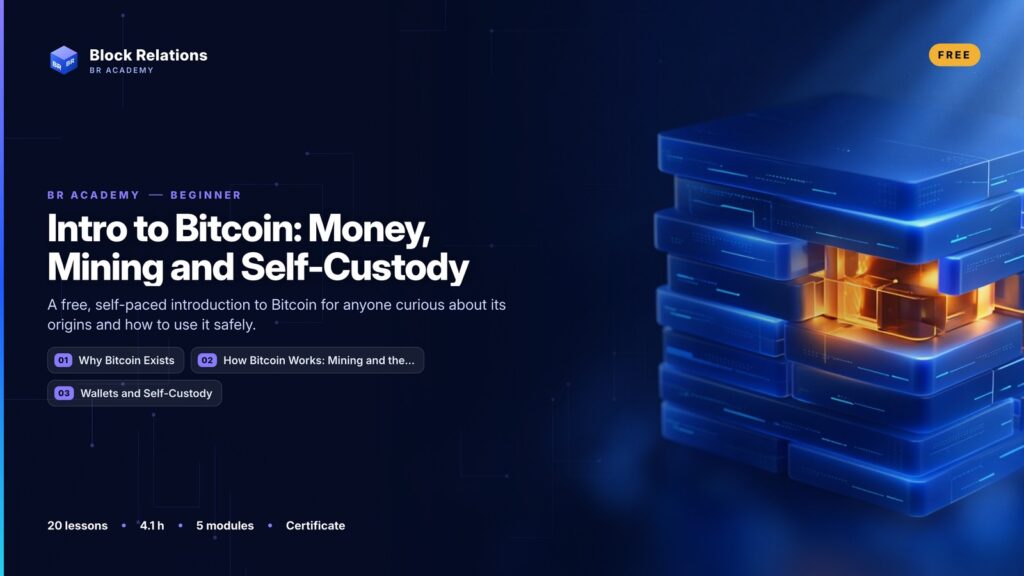
Intro to Bitcoin: Money, Mining and Self-Custody
A free, self-paced introduction to Bitcoin for anyone curious about its origins and how to use it safely. Learn why Bitcoin was created, how mining secures the network, and how to store and send Bitcoin without intermediaries.
FreeStart free →
 Free
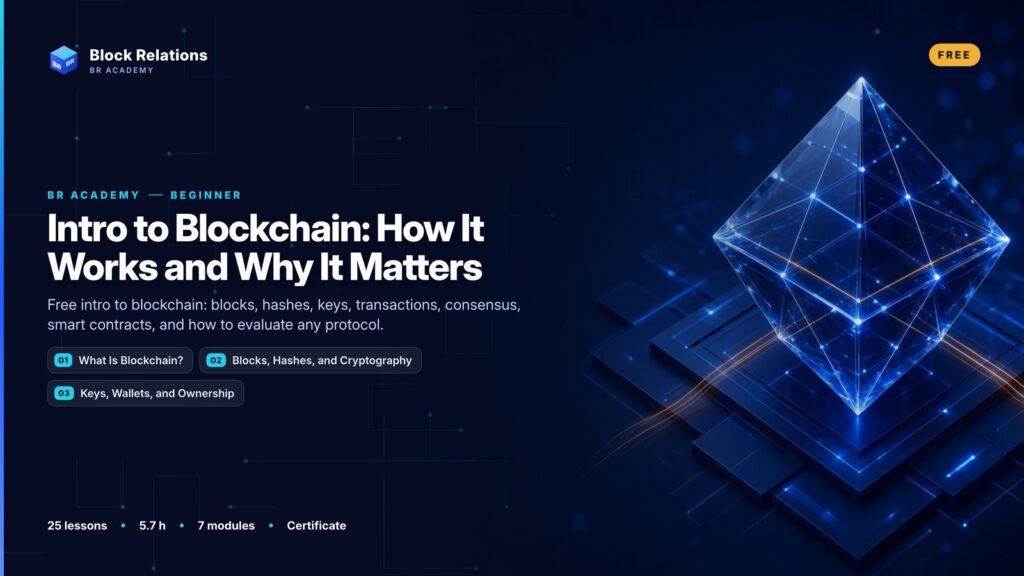
Intro to Blockchain: How It Works and Why It Matters
Free intro to blockchain: blocks, hashes, keys, transactions, consensus, smart contracts, and how to evaluate any protocol.
FreeStart free →